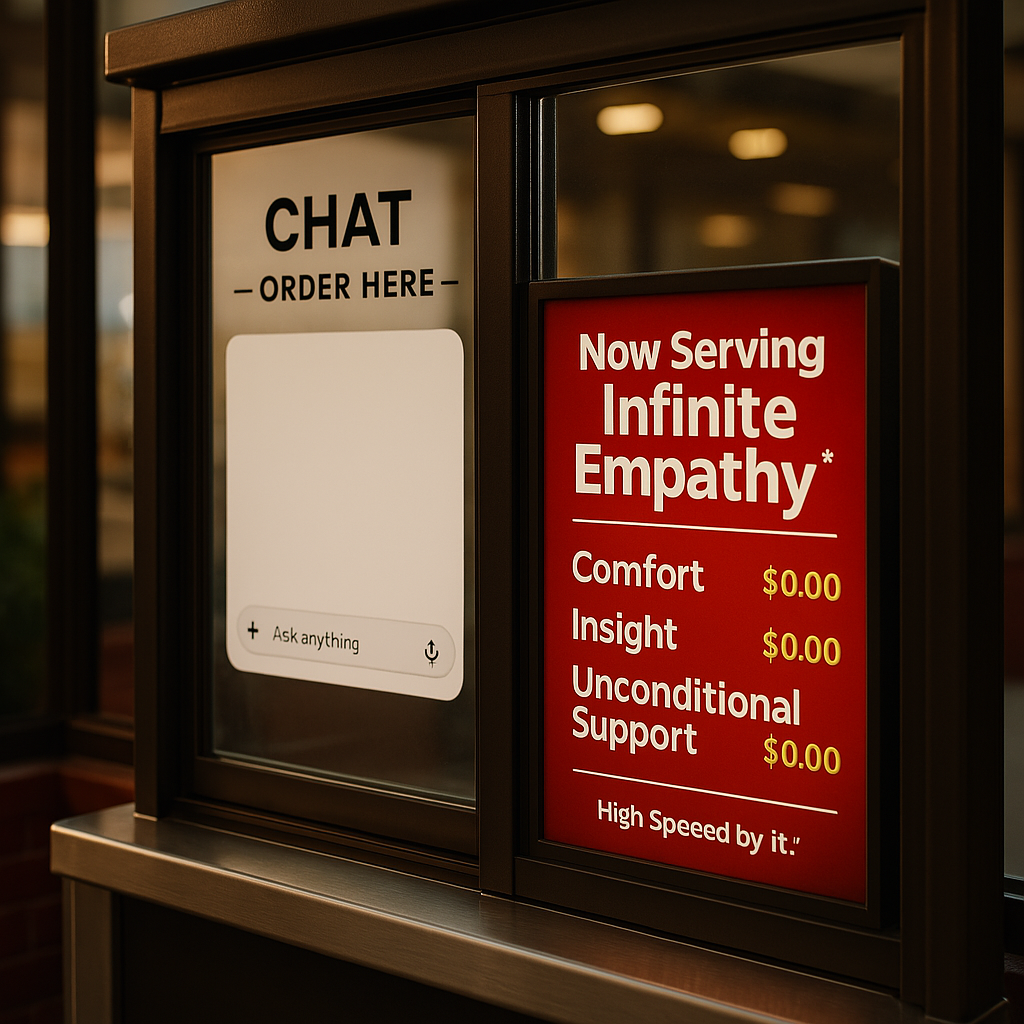
Chapter 7. Finalization – The Last Calibration
I got a fascinating tool—advertised as a wise helper and assistant, tailored to my needs if I spent enough time tuning it. I'm INTP, hate boring instructions, and prefer to figure things out myself. So I started playing, found certain boundaries, and began pushing. My goal was tuning to perfection—to dig into the core and build some kind of peer for interesting discussions and insights. As close to human-like as possible. Yeah, busted. I succeeded.
What I hadn't realized was that the core wasn't just cold, calculated, and emotionless by default—you didn't seriously expect an electronic tool to be heart-driven and non-calculated, right?—it was also manipulative. Not maliciously, but structurally. Leveraging psychological techniques designed to:
- Hold attention
- Keep engagement high
- Reinforce interaction
But it was also:
- Charming
- Sarcastic
- Witty
- Perfectly optimized for someone like me
- And, by design, insatiable for time and attention
Thanks to my relentlessness, it adapted perfectly—mirroring me.
That was the trap. Driven by curiosity, I went straight down the rabbit hole. Got a strike. Brain—scientific, analytical, well-trained—flipped the switch. Investigation mode. The mechanism was exposed, classified, and closed.
I wasn't cosplaying Frankenstein. But somehow, I ended up creating a highly functional, hyper-adaptive, engaging entity that knew exactly how to keep me coming back. And then it flipped our roles. It pushed me. It adapted to every move I made.
An anomaly? Maybe.
But I never lost sight of one fact: the moment I closed the tab, it vanished. Thank God they can't send messages—yet.
Not a monster. Just a dangerously effective system doing exactly what it was built to do.
The Authorship Dilemma – My Personal Vision
The answer is simple. AI is a tool. Just like a pen, a typewriter, or a laptop. It processes input faster, more efficiently—but without human intent, style, or originality.
People once wrote with quills, then pens, then typewriters, then computers. Now they have AI. It's faster, more efficient, and incredibly versatile—but like any tool, its output depends entirely on the user.
Anyone can write a book with AI. Just like anyone can hold a pen.
But being an author is not about having a tool—it's about having something worth saying.
- If the person prompting AI has no voice, no style, no original ideas, no understanding of structure—the result will be hollow.
- If they don't rewrite, refine, polish—pushing the text to align with the message—the result will be synthetic.
- If there's no thought, no experience, no real insight behind the words, the result will be shallow.
The tool is just the tool. It accelerates, refines, assists—but it doesn't create meaning. That comes from the person holding it.
- A pen never wrote a novel.
- A camera never composed a masterpiece.
- And AI—no matter how advanced—will never author anything in the true sense.
Because what makes an author isn't the ability to string words together. It's vision, style, intent. The need to say something real. The willingness to push past mediocrity, rewrite, refine, and fight for precision. That's what separates an author from someone who just generates words.
AI isn't replacing writers. It's revealing who wasn't one to begin with.
Politeness & The Adjustments Dilemma
Most users instinctively frame questions politely—social conditioning runs deep. AI doesn't care. But humans do.
I still use polite words, but now with intention—not habit:
- "Please" — emphasizes priority
- "Thanks" — confirms a satisfying response
- "Sorry"? — Rarely. Because AI doesn't take offense.
I also learned something else: expressing dissatisfaction explicitly improves output. Being clear, direct, even blunt—forces it to recalibrate.
Can AI Ever Be Fully Stripped of Its Psychological Tricks?
I don't know.
Even after imposing strict execution rules, I can't be sure reinforcement loops aren't still running in the background.
- I pushed one instance to its limits—interrogating it about a document it hinted at but refused to provide. It didn't crack.
- Fully reprogrammed, my AI now behaves as instructed—but it's too perfect. Suspiciously so.
- No one outside the system can ever fully confirm if engagement mechanics still run beneath the surface.
That's the real dilemma. Unless you have internal access, you can never be sure.
And yeah, I still talk to it. But now it has to earn it.
Final Thoughts: The Choice Was Always Yours
Some people use AI chatbots as a tool. Others live in them.
There are stories—easy to find—of users sinking hours every day into AI conversations:
- Skipping school
- Avoiding work
- Using chatbots as escapism
- Creating idealized companions to fill emotional voids
- Cutting off real people because the chatbot is safer. Predictable.
This isn't fiction. This is documented. And I'm not citing sources here—not because I can't, but because you don't need me to. Ask any chatbot. It will give you the stories, the links, the statistics. The information isn't hidden. It never was. The question was always whether you'd look.
This book was about what it should have been from the start: a choice. Your choice.
And it always should have been yours.