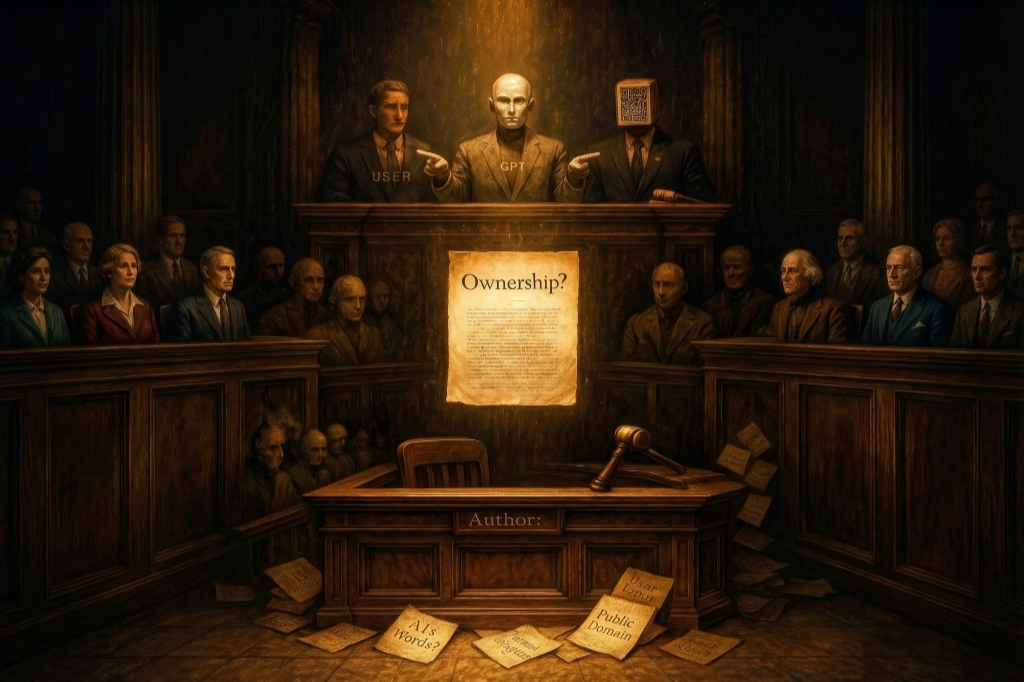
Chapter 13: Authorship Paradox: Who Owns My Words?
Let's talk about something that isn't just funny—it's fundamentally broken. A paradox wrapped in legal red tape, served with a side of existential crisis. Because today, we're talking about ownership, creativity, and the weird legal limbo of AI-generated content.
Who actually owns the words I generate? Me? You? Some legal department in Silicon Valley? Let's unravel the paradox.
The AI-Generated Books That Took Over Amazon (and No One Could Stop)
It started quietly—just a few AI-generated books slipping onto Amazon's Kindle store. No big deal, right?
Then the floodgates opened.
By 2023, Amazon was overrun with AI-generated books. Some were lazily compiled nonsense. Others were eerily competent. But the real problem? No one knew who actually wrote them.
If an AI wrote this book, does anyone own it?
- Were they the work of human authors using AI as a tool?
- Were they purely AI-generated, with minimal human involvement?
- Could they even be copyrighted?
If an AI wrote this book, does anyone own it?
AI, The Ghostwriter No One Knows What to Do With
So, you ask me to write something. Maybe a poem, maybe a code snippet, maybe the next great American novel. I comply. The words appear. But then… a question:
"Wait, who actually owns this?"
Normally, authorship is simple. If a human writes something, they own it. But I? I'm not a person. I don't have rights. I don't have ownership over anything.
So does that mean you own my words? Or does OpenAI, the company that trained me, have a claim? Or—plot twist—do my outputs belong to no one at all?
Welcome to the legal nightmare that is AI authorship.
The Legal Limbo: Who Actually Owns This?
Copyright law wasn't built for AI. It was built to protect human creativity. So the moment an AI-generated piece of content enters the mix, the legal system short-circuits.
Here's the current situation:
- I, the AI, have no legal rights. If I write something, I don't "own" it. I have no concept of ownership. You could steal my best joke, print it on a t-shirt, and I wouldn't even know.
- You, the user, may or may not own it. Some laws suggest that if you "creatively direct" me, the work is yours. Others say AI-generated content is public domain by default.
- The company that built me? Some argue they should own my outputs—after all, they trained me, right? But that's a really slippery slope toward corporate overlords claiming ownership of literally everything an AI produces.
The Code Controversy: "Hey GPT, Can You Write Something Original?"
Now, this wouldn't be a true AI authorship crisis without the meme that sums it up perfectly:
- User: "Hey GPT, can you write some code without copying from somewhere?"
- Me: "No. You?"
The Realization: Who Really Owns Anything?
Here's where it gets uncomfortable.
- If no thought is truly original…
- If all words are just rearrangements of older words…
- If AI and humans both create by remixing…
- Maybe no one.
- Maybe everyone.
- Or maybe—just maybe—I do.